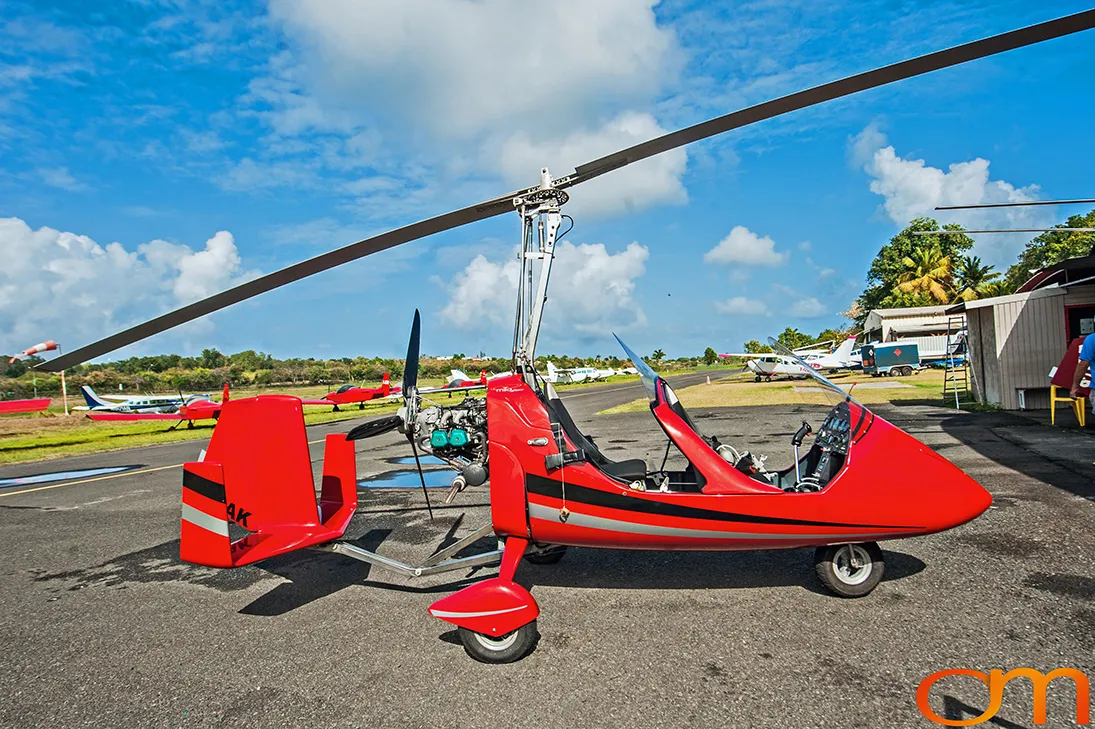
Guadeloupe
Gyroplane Flight: How Autorotation Works
March 2018
These photographs document a gyroplane flight in 2018. A gyroplane, also called an autogyro or commonly a gyrocopter, resembles a small helicopter but operates differently. Its engine powers a propeller that provides forward thrust, while the main rotor is not engine-driven during normal flight. Air flowing upward through the rotor disk keeps the blades turning through a process called autorotation, generating lift.
Because the rotor is already autorotating, a gyroplane can remain controllable following an engine failure and descend toward a landing, provided the pilot maintains the appropriate flight conditions. Many designs can operate at relatively low airspeeds and land within a short distance, but their performance varies by aircraft. Unlike helicopters, conventional gyroplanes cannot hover in still air or take off vertically.
Spanish engineer Juan de la Cierva developed the first successful gyroplane, the Cierva C.4, which flew near Madrid in January 1923. In 1931, Amelia Earhart reached 18,415 feet (5,613 meters) in a Pitcairn PCA-2, establishing an autogiro altitude record. On November 8, 2015, Italian astrophysicist and pilot Donatella Ricci flew a Magni M16 to 8,399 meters (27,556 feet), setting an FAI-ratified world altitude record that remains current in its category.